The short answer
An AEO audit asks AI tools the questions your patients ask, records each answer exactly as written, and shows for each tool separately whether your practice was recommended, named in passing or cited as a source, with the date and locations stated.
New to this? Start with Part 1: What Is AEO?
Key points
- A good audit asks real patient questions and asks each AI tool live.
- It reports each tool on its own and counts recommended, named in passing and cited as three separate results.
- It states the date and the locations, and keeps every answer exactly as written.
- Watch for a single blended score, projected revenue and unstated dates.
- The Acuven report is a one time purchase with no subscription, for one location or many.
An AEO audit is a measurement. It tells you what AI tools actually say about your practice, instead of what you hope they say. Not every audit is equally useful, so this guide covers what a good one includes, what to watch for, and what the Acuven report contains. For the background, start with Part 1.
What a Good Audit Includes
Real questions, every tool asked live, and every answer kept as it was written. Use this checklist on any audit you are offered, including an Acuven AEO audit.
- Does it use the questions your patients really ask? For example, where to get a particular treatment near them, or which practice to trust for it. Not just your own name.
- Does it report each AI tool on its own? ChatGPT, Gemini, Perplexity, Google AI Overviews and Google AI Mode behave differently, so each gets its own result.
- Does it state the date and the location? AI answers change. A result without a date, or without the location the question covered, cannot be checked or compared with a later one.
- Does it keep the answers exactly as written? You should be able to read exactly what the tool said, not only a summary of it.
- Does it count recommended, named in passing and cited separately? Being recommended, being named in passing and being linked as a source have different causes and value, so they are three distinct results.
- Does it name the competitors? Who the tools named instead of you, and what those practices have that yours lacks.
- Does it look at your own foundations? How readable your website is to AI tools, how complete your directory listings are, and what your reviews say.
Warning Signs in an Audit
Be wary of any audit that hides the method behind one friendly number.
- A single blended score. If one tool names you often and another never does, an average makes both look like "fine". The difference is the finding.
- Projected revenue. Any figure for lost patients or missed income is a guess presented as a measurement. A trustworthy audit reports what it saw, not what it imagines.
- Unstated dates. If you cannot tell when the questions were asked, you cannot tell whether the result still holds.
- A check that never asks the AI tools. A useful check puts real questions to the real AI tools with live search enabled. One that only reads your website is not measuring what patients see.
- A scare tactic. An audit built to frighten you into buying a service overstates the problem, offers no fix you can act on now, or asks for a subscription or a long term commitment before you see anything useful.
What the Acuven Report Includes
The report shows, for each AI tool, whether your practice was recommended, named in passing or cited as a source, and what to do about each result.
The Acuven report covers five AI tools: ChatGPT, Perplexity, Gemini, Google AI Overviews and Google AI Mode. Each is queried live and reported on its own. Every answer is recorded exactly as written, along with the date and the locations where the questions were asked.
This is what two pages of an Acuven report look like:
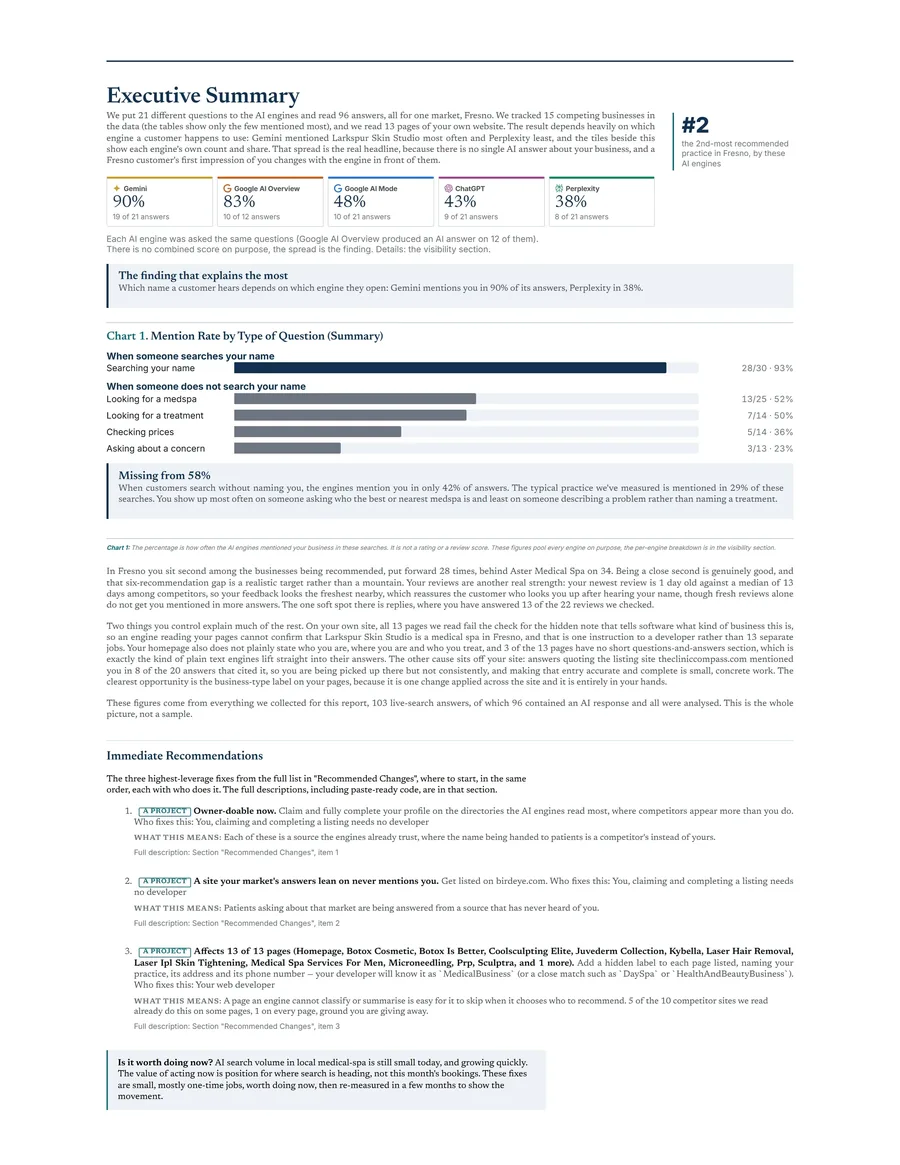
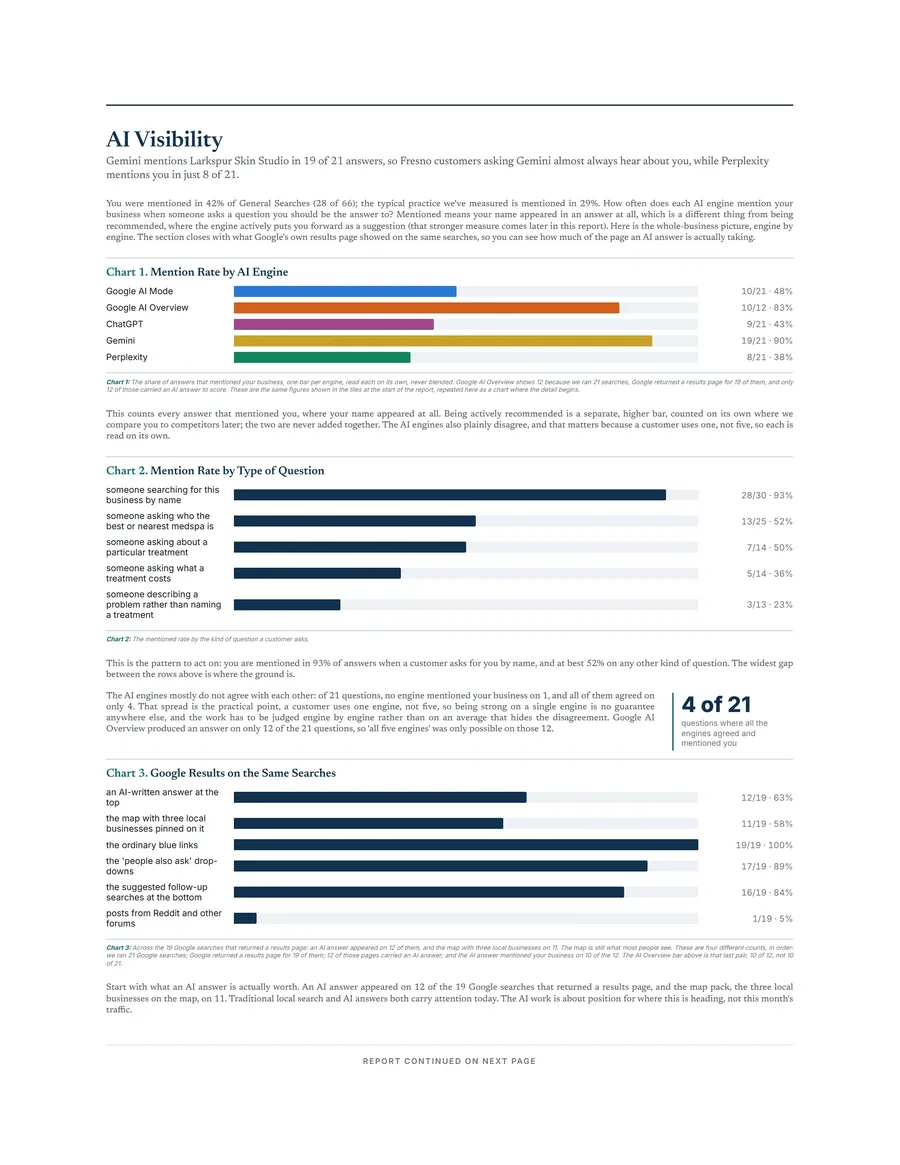
The report keeps the three ways of appearing apart, because each one calls for different work:
- Recommended. It shows where a tool offered your practice as a choice and where it offered a competitor instead, and compares what that competitor has with what you have.
- Named in passing. It shows where your practice appeared only as an aside, with the words the answer used, so you can see how the tool described you.
- Cited as a source. It shows which websites, listings and pages the answers linked as evidence, and which of them are yours.
The report ends with a plain language list of what to fix. It covers one location or many, with each location measured in its own market. AI search is a modest part of how local patients find a practice, and it is growing quickly, so the report shows where you stand now and does not promise bookings. It is a one time report with no subscription.
Also in every Acuven report
- One location or many in one report
- Competitors listed for each market
- Your visibility for each city or location
- Whether the AI tools know your brand
- Brands the tools mistake for yours
- Who is named in your place
- The sources each AI tool uses
- Directories where you are missing
- Your pages the tools cite as sources
- AI tools your site allows or blocks
- Your top competitor's site and yours
- Competitor review scores and counts
$49.99 for the first location and $5 for each additional location. One time, no subscription.
To get one, order a report.
Common questions
How is an Acuven AEO audit different from a free AI visibility check?
A useful check, free or paid, asks the real AI tools with live search enabled, shows the actual answers exactly as written, reports each tool separately, and says when and where the questions were asked. An Acuven report does all four. It also compares your practice with the competitors that were named.
Why should each AI tool be reported separately?
Because the tools disagree. Being recommended by ChatGPT and left out by Perplexity, for example, is itself a finding, and an average across the tools would hide it.
Does an Acuven AEO audit tell me how much money I am losing?
No. Acuven does not estimate lost patients or missed income, because those figures would be guesses. The report shows what the tools said and who they named, which is measured.
Can an Acuven AEO audit cover more than one location?
Yes. Answers depend on where the question is asked, so each location is measured in its own market. The Acuven report covers one location or many.
Spot an error? Email hello@acuven.com.
See what AI tools say about your practice
The Acuven report is a one time purchase with no subscription. It asks each AI tool the questions your patients ask, reports every tool separately, and keeps each answer exactly as written with the date and the locations where it was asked.
$49.99 for the first location and $5 for each additional location. One time, no subscription.
Order a Report